
Digital accessibility in the United States is no longer a “nice to have.” It’s a legal and ethical requirement, and one that increasingly affects photographers, publishers, and anyone managing large image libraries. At the center of this shift is something pretty simple to understand but time-consuming to implement: Alternative text, or alt text.
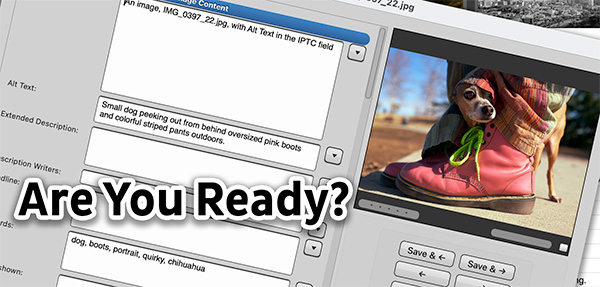
The Regulations: ADA, Section 508, and WCAG: Are You Ready?
Several overlapping frameworks govern accessibility in the U.S. The most prominent are the Americans with Disabilities Act (ADA) and Section 508 of the Rehabilitation Act. Together, they require that digital content, like websites, images, and documents, be accessible to people with disabilities.
In 2024, the U.S. Department of Justice updated ADA rules to explicitly address web and mobile accessibility for state and local governments, reinforcing that digital services must be usable by people with disabilities (ADA.gov). While the ADA itself doesn’t spell out technical details, it often points to the Web Content Accessibility Guidelines (WCAG) as the standard for compliance (ADA.gov).
One of the most fundamental WCAG requirements? Every meaningful image must include descriptive alt text. In fact, alt text is considered a baseline requirement. Without it, content is inaccessible to screen reader users (Section508.gov). Section 508 similarly mandates text alternatives for non-text content, making alt text a legal necessity for federal agencies and a de facto standard across industries (WCAG).
In short: if you publish images online, whether for journalism, government, nonprofits, or commercial use, you need alt text. And you need it at scale.
The Real Challenge: Volume
For photographers and media organizations, the barrier isn’t understanding alt text, it’s applying it consistently across thousands (or tens of thousands) of images.
Some organizations choose to work with accessibility consultancies that provide human-written alt text as part of broader compliance and content workflows. These services typically combine subject-matter awareness with editorial judgment, producing descriptions that are more accurate, contextual, and aligned with organizational voice than automated tools alone. While often used for high-value or public-facing image libraries, they are most effective when paired with scalable metadata workflows that allow those descriptions to be efficiently applied across large collections.
Manually adding alt text one image at a time in a CMS is slow, error-prone, and often unrealistic. This is where metadata workflows become critical, and where Photo Mechanic stands out.
Photo Mechanic: Built for High-Volume Metadata
Photo Mechanic has long been known as a fast ingestion and captioning tool for professional photographers. But its role in accessibility workflows is becoming increasingly important.
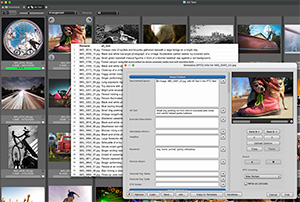
Because Photo Mechanic writes directly to IPTC metadata fields, it allows users to embed alt text at the file level, before images ever reach a website. This ensures accessibility information travels with the image, rather than being added later (or forgotten entirely).
Even more powerful is its ability to apply alt text in bulk using a spreadsheet workflow. You can prepare a simple spreadsheet with filenames and corresponding alt text, then use Photo Mechanic to match and apply that metadata across an entire folder of images in one pass. For organizations dealing with archives, event coverage, or daily publishing cycles, this can mean the difference between compliance and backlog.
Why IPTC Matters More Than Ever
Embedding alt text in IPTC metadata isn’t just efficient, it’s future-proof. Increasingly, platforms are recognizing and using this embedded data automatically.
For example, WordPress now surfaces IPTC alt text when images are uploaded and published. That means photographers and editors who prepare metadata upstream using Photo Mechanic can ensure accessibility fields are already populated when content goes live, without additional manual steps.
Accessibility as Workflow, Not Afterthought
The growing body of U.S. regulations makes one thing clear: accessibility is not optional. Alt text is a minimum requirement for compliance with Section 508 and is frequently cited in ADA-related standards and enforcement actions (Level Access).
But beyond compliance, there’s a practical reality. Organizations that fail to build scalable workflows for accessibility will struggle to keep up with the volume of content they produce.
By enabling fast, consistent, and bulk application of alt text through IPTC fields, Photo Mechanic turns what could be a bottleneck into a streamlined part of your production pipeline.
The Bottom Line
Accessibility regulations in the U.S. are evolving quickly, but the direction is clear: digital content must be inclusive, and when it comes to doing that with displaying your images online, alt text is how that gets done.
For teams managing large image collections, the question isn’t whether to add alt text, it’s how to do it efficiently and reliably. With its high-speed workflow, deeply customizable processes, and support for IPTC standards, Photo Mechanic from Camera Bits is uniquely positioned to meet that challenge.
Accessibility starts with intention, but it scales with the right tools.