
On September 22, media and technology professionals gathered atop Mount Fløyen in Bergen, Norway, for the 2026 Media Provenance Summit. Organized by the BBC, IPTC, and Media Cluster Norway, the event focused on moving content authenticity beyond promising demonstrations and into practical editorial workflows.
That practical emphasis made this year’s Summit especially relevant to Photo Mechanic users working in journalism and other trust-sensitive fields.
As we’ve shared, Camera Bits is developing Content Authenticity features for Photo Mechanic based on the C2PA standard. Our goal is to make image provenance practical, reliable, and fast for working photographers, without requiring them to become experts in manifests, cryptographic signatures, and trust chains.
According to IPTC’s post-event recap, speakers from the BBC, AFP, CBC/Radio-Canada, and Paris Match shared their ongoing work producing C2PA-signed content. The Summit also highlighted a project representing more than 80% of the Norwegian newspaper industry, vendor demonstrations, and Microsoft Research’s work on how provenance information is presented to audiences.
The published program included a Norwegian newspaper pilot presented by Show Your Work Lab, a Proofmode pilot with CBC/Radio-Canada, and an IMATAG presentation on provenance from capture to publication. It also included insights from the Project Reynir collaboration and workshops on collaboration, advocacy, authenticity, and standardized media asset workflows. Together, these topics brought the practical challenges of newsroom production and publishing into focus.
“Provenance has to work across the entire journey of a photograph,” said Dennis Walker, our founder and president. “It isn’t enough to establish authenticity at capture. That information also has to remain useful as an image moves through editing, delivery, content-management systems, and publication.”
Camera Bits has been working with Sony cameras, Show Your Work Lab, and IMATAG on workflows in which Photo Mechanic plays a role. Show Your Work Lab helps news organizations build end-to-end provenance workflows that make visual journalism more verifiable, transparent, and trustworthy. IMATAG develops invisible watermarking and visual-recognition technology designed to help protect content and preserve a path back to its provenance.
That combination framed one of the most important questions facing the industry: What happens when a conventional publishing system removes associated metadata?
“Proving provenance has always been a challenge going back to ancient artworks,” said Walker. “With the digital age, we can start with cryptographic provenance at capture, but maintaining a chain of editorial evidence through many systems from photo ingestion, editing, delivery, content-management systems, and finally to publication can be a real challenge for provenance. Unfortunately, with AI slop it is now a necessity. Trust must be restored with reality.”
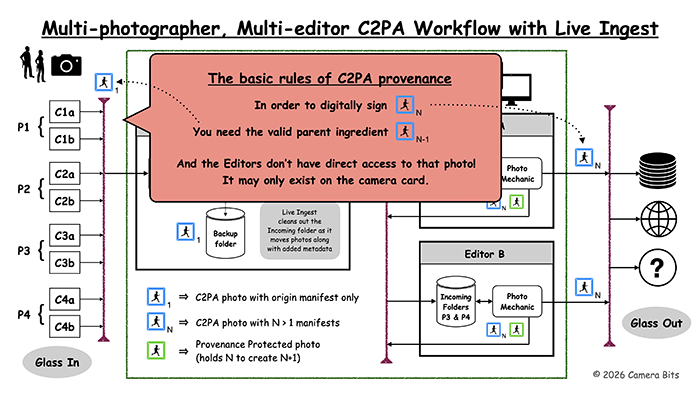
Along with Sony and IMATAG, Camera Bits has been working with various news publishers and working groups, such as Show Your Work Lab, to identify these implementation challenges and suggest provenance workflows that provide a cryptographic path of provenance from camera glass to monitor glass (“glass-to-glass”). Photo Mechanic’s role in these developing workflows is to help preserve provenance at the first stages of image ingestion and handling. C2PA-aware software is essential to carrying that information through subsequent production steps.
The work with IMATAG addresses another part of this challenge: helping readers and publishers find provenance information when embedded metadata has been removed. An imperceptible watermark can link a photo to a C2PA manifest store stored in “the cloud,” providing another route to its provenance and copyright information. The watermark can “survive” various common image manipulations and remain detectable, potentially allowing that information to be recovered even when a publishing system strips embedded metadata.
“Real-world testing is essential because every organization has different workflows and systems to integrate with,” said Walker. “I like to joke that when I ask a single photographer what their workflow is with Photo Mechanic, they give me at least two or three answers. And these differences are important to maintain a flexible yet efficient workflow for photos as sensitive as C2PA-signed photos.”
For Camera Bits, the Summit’s focus on practical implementation reflected a longstanding priority: helping photographers move images quickly while protecting the information that gives those images meaning. Content authenticity adds a new dimension to that mission: one that matters to photographers, news organizations, competitions, brands, and audiences alike.
Ahead of the Summit, Walker described what he hoped to accomplish: “In Bergen I look forward to comparing what different organizations have learned and help them identify next steps,” said Walker. “A core tenet of C2PA conformance is interoperability, and this requires collaboration with all stakeholders.”
Dennis shared this outline reel of the Photo Mechanic solution at the conference: